

Some books entertain us for a few hours.
Some books educate us for a season.
A rare few continue to shape the way we think, long after we have turned the final page.
The 7 Habits of Highly Effective People by Stephen Covey is one of those books.
First published in 1989, it has influenced millions of people worldwide, from students and parents to leaders and entrepreneurs. While the world has changed dramatically since then, the principles behind the book remain remarkably timeless because they are built on human character rather than changing trends.
This isn’t a chapter-by-chapter summary of the book.
Ai can already do that remarkably well.
Instead, this article is my interpretation of the principles that have stayed with me over the years, how life has tested them, and how they continue to influence the way i live, work, and learn today.
Why This Book Still Matters
Technology evolves.
Industries change.
The way we communicate, work, and create has transformed countless times.
Yet one thing has remained surprisingly consistent – human nature.
We still struggle with procrastination.
We still wrestle with priorities.
We still seek meaningful relationships, purposeful work, and a life worth living.
That’s why The 7 Habits of Highly Effective People continues to resonate decades after its first publication. It doesn’t teach shortcuts. It teaches principles.
And principles have a habit of outliving tactics.
Change How We See the World
Before introducing the seven habits, Stephen Covey begins with something even more fundamental: our paradigms.
A paradigm is the lens through which we see and interpret the world. It shapes our assumptions, influences our decisions, and ultimately determines our actions.
If our map is inaccurate, moving faster only takes us further off course.
A positive attitude alone cannot compensate for a flawed perspective.
Changing our lives often begins by changing how we see them.
Alongside paradigms are principles, the timeless truths that guide our decisions regardless of circumstances. While methods may change with time, principles remain constant.
One lesson from this section has stayed with me ever since:
“Responsibility is about putting the ownership of life back into the hands of the one living it.” – Max Yeo
When we accept responsibility for our choices, we also reclaim the power to change them.
Master Ourselves Before Leading Others
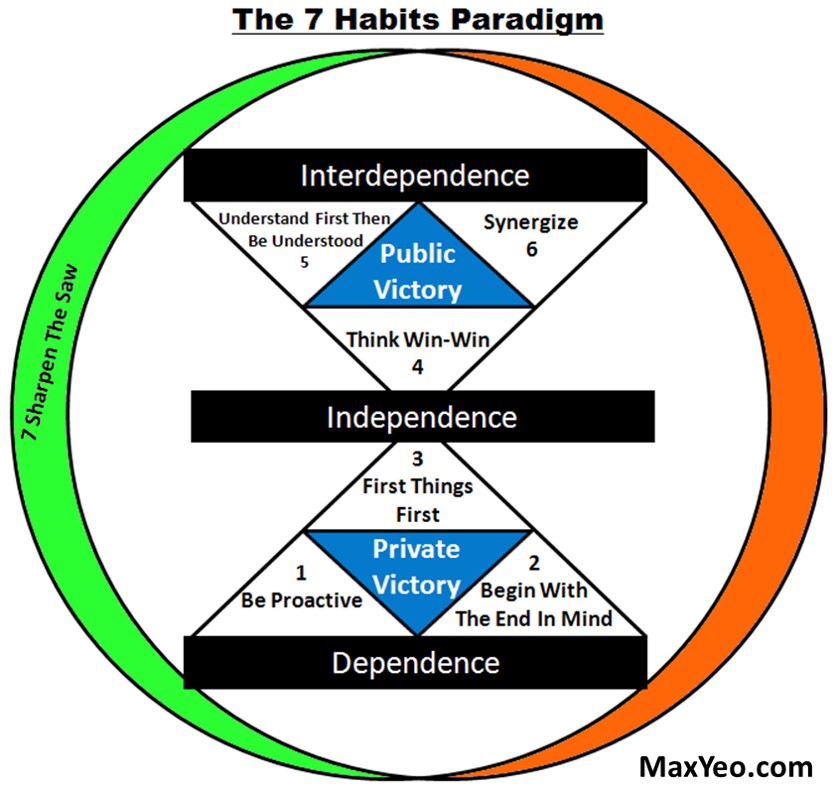
One of the most profound ideas in the book is that public success begins with private victory.
Before we can lead teams, influence others, or build meaningful relationships, we must first learn to lead ourselves.
That means taking responsibility for our responses, because change starts from within.
Living according to our values.
Managing our priorities instead of reacting to whatever feels most urgent.
Being a gamer, i’ve always enjoyed comparing this idea to strategy games.
In games, we don’t simply command armies. We manage resources, develop our strengths, research improvements, build supporting systems, and prepare for challenges before they arrive.
Life works much the same way.
Our health, energy, mindset, relationships, finances, knowledge, and habits are all resources that require intentional management.
Private victory isn’t glamorous.
Most people never see it.
But it’s often the invisible foundation behind every visible success.
Success Is a Team Sport
Once we learn to lead ourselves, the focus naturally shifts towards leading with others.
The remaining habits remind us that long-term success is rarely achieved alone.
Relationships thrive when we seek mutual benefit rather than personal victory.
Communication improves when we understand before trying to be understood.
Teams become stronger when differences are viewed as strengths instead of obstacles.
As the old saying goes, if we want to go fast, we can go alone; if we want to go far, we go together.
Individual excellence may help us move faster.
Shared excellence helps us go further.
The Seven Habits at a Glance
Each habit builds upon the previous one, creating a progression from personal effectiveness to meaningful contribution.
Habit 1: Be Proactive
Recognise that while we cannot control every circumstance, we can always choose our response.
Habit 2: Begin with the End in Mind
Clarify the future we wish to create so today’s decisions move us in the right direction.
Habit 3: Put First Things First
Organise our lives around priorities rather than urgency.
Habit 4: Think Win-Win
Seek solutions where everyone benefits instead of treating life as a competition.
Habit 5: Seek First to Understand, Then to Be Understood
Build trust through genuine understanding before expecting others to understand us.
Habit 6: Synergize
Value differences and combine strengths to create results greater than what any individual could achieve alone.
Habit 7: Sharpen the Saw
Continually renew ourselves physically, mentally, emotionally, and spiritually so we can continue growing over the long term.
Each habit can stand on its own.
Together, they form a practical framework for living and leading more effectively.
Where Should We Begin?
Different seasons of life call for different habits.
If we feel that life is happening to us, begin with Habit 1: Be Proactive.
If we lack direction, Habit 2: Begin with the End in Mind provides clarity.
If we constantly feel busy but rarely make meaningful progress, Habit 3: Put First Things First offers a better way to prioritise.
When relationships become difficult, Habits 4, 5, and 6 remind us that trust, understanding, and collaboration often achieve far more than competition ever could.
And whenever life starts to feel overwhelming, Habit 7: Sharpen the Saw reminds us that growth requires renewal.
Final Thoughts
Over the years, I’ve read many books on leadership, productivity, psychology, and personal development.
Very few have remained as relevant to me as The 7 Habits of Highly Effective People.
Not because it promises quick success.
But because it encourages us to become the kind of person who can sustain success.
The tools we use will continue to change.
Technology will continue to evolve.
Ai will continue to transform how we learn and work.
But character, responsibility, and timeless principles will always matter.
That’s why I still recommend this book today.
Not as a collection of habits to memorise, but as principles to practise.
Because books may change how we think.
Only applying their lessons can change how we live.
P.S. i wrote this years ago, and today i have Ai to help me to rewrite and express myself better.